Sufi dancers in Omdurman

Pix Sufi dancers in Omdurman

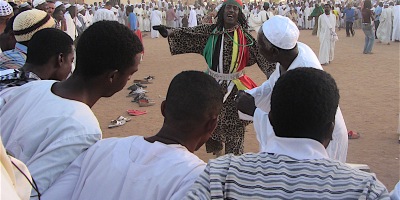
Sufi dancers in Omdurman (Pix: Alison Bate)


Sufi dancers in Omdurman

More Sufi dancing in Omdurman (Pix: Alison Bate)


It seemed an indelicate way to arrive at a religious ceremony. We bumped in, out and around gravestones set in desert scrub, before pulling up in the minivan in front of a huge circle of men in white robes.

The pounding beat got louder as we walked to the edges of the circle and saw what they were all watching: green, red and leopard-clothed mystics swirling and dancing in a hypnotic fashion in the middle of the circle.

Their faces told the story: blissful is the only way to describe it. The bumpy ride forgotten, all things forgotten but the compelling dancing, chanting and smiling faces.

It was Friday evening in Omdurman and I’d never seen the Sufi dancers before, despite living in Sudan for five months in 2007. At the time it seemed too touristy, and a long way to go on my one day off a week. Big mistake.

If you go to Khartoum, it’s definitely worth taking the tour arranged by the Acropole Hotel every Friday from 3pm. You don’t have to stay at the hotel to go, but pay about 30 Sudanese Pounds and you’ll see lots of sights and, most importantly, end up at the Sufi dancing in Omdurman.

To learn more about the Sufi religion, I enjoyed reading this post: Sufism in Sudan, Part One. Here’s an excerpt about the ceremony:

“The Hamad al-Neel cemetery—a vast, dun-colored cemetery in Omdurman—is the headquarters of the al-Qadiriya order in Sudan and was founded by sheikh Hamad al-Neel, who is buried at a nearby mosque.

“The expanse serves as an attraction for tourists and photographers due to the nature of the order’s rituals, which combine African heritage, dance, music and colorful attire.

“On Friday at 5 pm, the cemetery fills up with people of all ages, ethnicities and walks of life who come to be a part of the rituals, while tea sellers and pamphlet vendors surround the area around the tomb site.

“The dervishes are dressed in red and green, patchwork, leopard-prints or flowing white ‘jellabiyas’ and ‘immas’ (turbans). Some sport dreadlocks, amulets and talismans, and others don on colorful hats and enormous strings of prayer beads.

“Standing barefoot above the sand and under the heat of a sizzling sun, a few men pick up the rhythm on their ‘tambours’ (drums) and chant ‘zikr’ melodically while the crowd swells palpably, grooving to the rhythm.” ((Continued in Sufism in Sudan, Part One)

(Posted by Alison Bate on Jan.1, 2012)

Surprise in the souk

“Do you dare to wear it?”
– 1974 advert for Bint el Sudan perfume

Mar.22, 2011

By Alison Bate

It was my last day in Khartoum, the dusty desert capital of Sudan. I lay spread-eagled on my bed, trying to keep as cool as possible, and planning the day ahead.

I’ll visit Omdurman Souk, I decided, follow on my grandfather’s trail. After all, it was thanks to Grampy and his “expert nose” that I was in Africa at all.

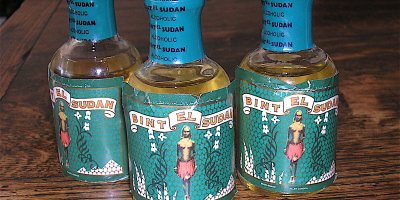
Pix perfume bottle

The original Bint oil perfume (non-alcoholic)

Omdurman is Khartoum’s sister city, and I first heard the name from my globetrotting grandfather. It was on one of his trips that the perfume Bint El Sudan was born, after a meeting with Omdurman merchants. It quickly became the best-selling non-alcoholic perfume in the world.

Eric Burgess, known in the style of the times as E.E. Burgess Esq., was a traveling perfume salesman for W.J. Bush & Co. of Hackney, East London.

His mission? To sniff out new markets for exotic perfumes. Like his father before him, Eric Burgess started at the company as a youngster and stayed with Bush for 50 years. It was a family tradition: his grandfather and great-grandfather also traded in chemicals of some kind. And as an export manager and buyer, he travelled all over Africa, the Middle East and Europe, often in very remote areas.

“He lived at a time when you could have real adventures,” his younger daughter Elizabeth – my Mum – recalled.

As a young child, she remembers him flying in a small plane over their garden in Kent, waving a large white hankie out the window as he headed across the English Channel on yet another long trip.

I grew up listening to my grandfather’s travel tales at his home in Kemsing, Kent – the cozy English village he lived in for 60 years.

NOTE: A shorter piece, “The Bint Factor”, was published by Reader’s Digest Canada in December 2009)

Grampy’s home was full of elephants: ivory tusks carved with a row of elephants; book-ends with ivory elephants at each end; and a carved wooden elephant stool on the landing near the top of the stairs.

His wife Ann died when I was only eight, so my memories are of him living alone, but very comfortably, in the same grounds as Auntie Pat, Uncle John and our cousins Simon and Roger.

Grampy in retirement

Travelling with my grandfather in France

Even in retirement, Grampy dressed immaculately in a jacket, long-sleeved shirt and tie, waistcoat, carefully creased trousers, braces and well-polished leather shoes.  

He’d tell of his adventures with an infectious chuckle, bushy eyebrows twitching, glasses at the end of his nose, and a cigarette with a full inch of ash wedged between his fingers.

My brother Tony, sister Gill and I would watch fascinated, wondering when the ash would fall off, as we listened to how he’d had to shoot a man in Africa or helped toss a dead thief off a train.

Grampy told one of his stories in the company’s Albright magazine in February 1965, shortly after he retired.

Journeys overseas took months in his early days, sometimes more than a year, and he was a regular on the Continental long distance trains. Late one night in the Balkans, he was in a sleeper when he heard a noise in the corridor:

“I left my compartment and saw the attendant bending over a fellow lying on the floor. Apparently the guard had caught him stealing, the thief had drawn a knife and the guard had shot him,” he recalled.

“I asked what he was going to do about it and he said quietly: ‘Give me a hand to shove him out’ – and we did, out of the window”.

In another interview, this time with The Sunday Times of London, Eric Burgess recalled an unplanned six days in the desert.

“We crossed the desert from Damascus to Baghdad in a fleet of Cadillacs with enough food for a week in case we got stuck with the rain coming. But we reached one patch of mud 25 yards across and it took us two hours to get through it.

“We all fell flat on our backs and I arrived in my office in Baghdad covered in mud. I caught sight of myself in a mirror and, good heavens, I realised I hadn’t got a tie on.”

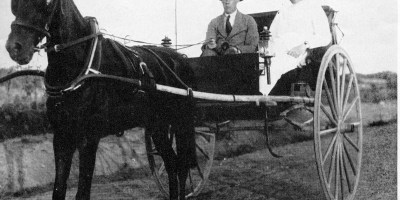
Grampy (right) riding in Africa

In Africa, he travelled on mules, horses or walked on foot. Dressed smartly in a jacket, tie and pith helmet, armed guard in tow, he’d visit the markets, tribesmen’s huts or little shops, tracking down new essences, exploring and opening up new markets for the company, and returning to collect new orders.

Bint is born

It was on one of his early expeditions that Bint was born, after Eric Burgess set out for Abyssinia (now Ethiopia) and Sudan in 1919 with several large leather cases and a strong trunk, tightly strapped.

As he told it, one blazingly hot day a group of 14 Omdurman merchants “looking like brigands” crowded into the small office used by the company representative in Khartoum.

After squatting on the floor and drinking several cups of thick strong coffee, as was the custom, they produced a large number of exotic essences, including jasmine, lilac, lily of the valley, musk and amber.

They asked my grandfather to use them to make the perfect perfume for Muslims. Strict Muslims don’t touch alcohol, so the perfume had to be oil-based, a more expensive process.

Bint el Sudan, my grandfather. . .and me

My grandfather E.E.Burgess, left, and another W.J. Bush agent in Africa

On a trip that took me to Africa, I found my grandfather’s lasting legacy—the continent’s signature scent—in a market in Sudan.

This story “The Bint Formula” was published in the December 2009 issue of Reader’s Digest Canada magazine.

For more information about Bint el Sudan, see the following:

* Surprise in the Souk

* Memories of Bint el Sudan

* 36 bottles of Bint el Sudan

* The history of Bint el Sudan (on Perfume Projects’ website)

* Where to buy Bint el Sudan in North America